Everyone loves a good wedding and everyone loves a good song. Personally, after my last bout with the insane scourge of Weil's disease, I'm not so keen on rivers. But, as that great philosopher Meatloaf once said, "Two out of three ain't bad," and, "Objects in the rear-view mirror may appear closer than they are."
Actually, Meatloaf was one of the few people who didn't turn up in this episode as Steven Moffat repeated his trick from The Pandorica Opens of bringing back old faces for a finale.
So it was that we got Churchill and the dodgy fat blue bloke with the money, the crew of the Teselecta, River Song, Madame Kovarian, the Silents, Rory and Amy. We even got a sort of appearance from the Brigadier, even if it was only in the form of a slap-in-the-face announcement that he'd died.

But this was a different world from the one we know, as River Song broke free of her programming to refuse to kill the Doctor, causing a collapse of the barriers of time that left all eras of human history mangled up, with the Pyramids in America, pterodactyls in London and Charles Dickens on TV.
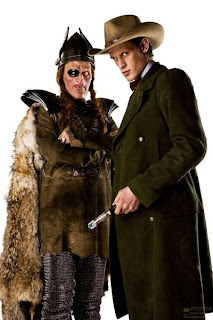
Of course he can. He can get River Song to agree to kill him after all. And, after he sort of marries her, she does just that, making everything right with the world.
Well, apart from the fact our hero's dead.
Except he isn't - because he's been sneaky and, instead of sacrificing himself, has instead let River Song shoot Let's Kill Hitler's Teselecta, disguised as him to fool the Silence into thinking he's dead.
Just one look at the episode's opening sequence, with its shot of cars flying over the Gherkin while suspended from balloons, reminded us the Grand Moff likes to keep the big budgets for his own episodes, and so we got a curious kind of epic that managed to often be big in visual scale while small in mind-set, a kind of sci-fi version of those Agatha Christie scenes where Miss Marple stands in the drawing room and explains just who did what and how.
Despite all Moffat's weavings, twistings and turnings, you can't escape the feeling of a cop-out. After all, in order for Time to be put right, the Doctor has to die.
But he didn't.
It was the Teselecta that "died". A robot that looks like him might fool the Silence but it surely wouldn't fool Time itself. A lot of fans had speculated that the Doctor killed in The Impossible Astronaut was a ganger duplicate which, while it would've been more obvious, would've made more sense in the context of the story as, physically and mentally, it would've been the same being as the Doctor. On top of that there's the question of exactly how the Teselecta started to regenerate.
River Song in the closing moments really does come across as unacceptably smug with her revelation that she knew what was going on all along in The Impossible Astronaut and Day of the Moon but was just pretending she didn't. A cynic would suggest she acted like she didn't know because Moffat at that point didn't know either.
Either way, the happy as Larry, "I'm so clever," way she made this revelation to Amy really did make her come across as a total bottom-hole. If I'd been Amy I'd have put her over my knee and given her a good spanking.

Coming across much better was Amy in the alternate time-line, now in charge of Area 51 and its battle with the Silence, happy to give Madame Kovarian a good comeuppance with her own murderous eye patch. That's the sort of thing I like to see in a drama.
Alternate Rory was great too, showing his never-ending loyalty and willingness to endure agony and death for the cause. You did have to feel sorry for him as the Silents taunted him about his tendency to die more often than a bad comedian at the Glasgow Empire.
Not so good were the killer skulls in the catacombs of the Headless Monks. Skulls might be scary in theory but they tend to just look plain silly when they're wobbling about on a shelf, trying to eat you.
 So, now we have to look forward to the Christmas Special and next year's season, wondering just what form the show'll take from now on. There was a strong hint that the tendency to make the Doctor the centre of the universe is to be scrapped, with him returning to the more anonymous figure he was in the days of Hartnell and Troughton.
For some of us this can be no bad thing, as I've complained in previous reviews about the show having become too insular under Moffat, with seemingly everything that happens in all existence coming down to the Doctor and his companions. Call me old-fashioned but I tend to take the view that the universe is a big place and the heroes shouldn't be bigger than it.
Even now there're unanswered questions. We still don't know exactly who the Silence are or just what's behind them. Nor do we know the significance of the revelation that the oldest question in the universe is, "Dr Who?" Will these matters be carried on into a future storyline or simply forgotten?
Only time will tell.
But then, Time can't even tell if the Doctor's dead. Sometimes Time, like rivers, can be a very big disappointment to you.


 Posts
Posts