Saturday, 15 September 2012

A Town Called Mercy. Review.

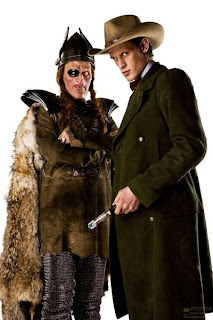
Dr Who, A Town Called Mercy, Stetsons are cool and Rory holds a dead animal

Speaking as someone who's only ever seen four Westerns all the way through, and one of them was Carry on Cowboy, I was always going to approach a Wild West themed episode of Doctor Who with the wariness of an ageing rattlesnake.

But, with the open-mindedness that's made me as big a legend on the plains as Calamity Jane, that didn't stop me sitting down to watch it.

A Town Called Mercy finds our heroes confronting a problem.

That problem's a cyborg gunslinger who wants the locals to hand over an alien who's living amongst them.

 Or else.

That alien is Kahler Jex who, since his arrival, has provided the town with a power supply and saved everyone from cholera, making him a valuable asset to the locals - especially to Ben Browder's Sheriff Isaac, a man determined to keep him alive and to maintain civic unity in the face of danger.

The moral choice seems simple until the Doctor discovers Jex is the war criminal responsible for creating the cyborg in the first place. Now the Doctor has to make a decision. Is it better to hand the man over to meet his death, or to let him live and escape the consequences of his actions?

It's not the first time the show's handled the dilemma in question. Christopher Eccleston was faced with exactly the same one way back in Boom Town. As in that episode, it provides the opportunity for soul-searching on the part of the Doctor, as well as plenty of talky bits. As in that one, the Doctor ultimately doesn't have to face up to the responsibility of making the decision.

This can only be viewed as a cop-out by writer Toby Whithouse but, given that Doctor Who's primarily designed to be family fare, the truth is it's difficult to see how it could ever respond to such a challenge without being forced to cop-out in some way.

Despite my fears before watching it, this is by far the best episode of this season so far, reminding us again that Doctor Who isn't Star Wars and nor is it a sit-com. Instead, it's at its best when it drops the silliness and loses all pretensions of epicness, in order to simply concentrate on telling a story about people.

I really don't have that much to say about A Town Called Mercy because there's really not much to criticise. Maybe Isaac's death failed to carry the emotional impact it was meant to, I could have done without the cyborg talking to itself as it stalked the town, and Karen Gillan didn't act as good as she looked but these are minor failings that did little to undermine the success of the outing.

Whithouse even solved the too-many-companions problem, by sidelining Rory to such a degree it was a genuine shock to me when he suddenly reappeared in a scene and reminded me he was actually in this week's episode.

It'd be nice to think every episode from now on could be as successful as this one but we all know we don't live in a perfect world and, like a drunken cowpoke, the show will as always lurch around from good to bad. Still, it can at least for this week ride off into the sunset, with its head high and its stetson proud, as we wait to see what awaits it over the next horizon.

Friday, 14 September 2012

Dinosaurs on a Spaceship. Review.

Dr Who, dinosaurs on a spaceship, Amy Pond and Queen Nefertiti of Egypt look perplexed

Our weekly fix of Primeval may have been taken from us but can the show whose success inspired its creation fill the gap? The blog that laughs in the face of velociraptors finds out.

In the far future, a spaceship’s about to crash into the Earth, so the Doctor gathers together all the people he’s going to need to make this week’s episode work – including Queen Nefertiti, a big-game hunter and Rory’s dad  - and sets off to the spaceship.

There, they discover the vessel’s an ark launched millions of years ago by the Silurians in order to preserve the dinosaurs.

That’s the good news.

The bad news is a crook called Solomon’s had his robots throw the entire crew out of an airlock and is now out to sell off the dinosaurs and anything else of worth he finds on board. Possibly good news for Rory’s dad but not such good news for Queen Nefertiti.

I can’t deny I came to this with low expectations, having hated all of Chris Chibnall’s previous scripts for both Torchwood and Dr Who, and it has to be said that early on in the episode it looks like my fears are to be justified, as it seems we’re going to have to endure the horrors of a comedy episode, complete with crass and inappropriate jokes. On top of that, lowering himself to the level of his script, Matt Smith is quickly reduced to gurning mode.

But, magically, all is transformed when Solomon makes his appearance.

Solomon’s a truly nasty villain, played beautifully by David Bradley, his appearance suddenly giving the episode a welcome edge and pushing it back into the direction of being actual drama. There’re still lapses after that - the escape by triceratops being particularly silly and nonsensical. Yes, if you want to flee death rays, climb on board a slow lumbering animal. It also has to be said that Mitchell and Webb’s voicing of Solomon’s robots seriously undermines  the triceratops escape scene, totally robbing it of any tension.

We also get Chibnall’s habit of recycling old Who ideas into pastiche, while his traditional inability to get into the heads of his characters gives us a Doctor who’s good friends with a big game hunter. Surely the current Doctor would despise such a character?

And exactly why does the Silurian spaceship need two genetically related pilots? It’s a contrivance clearly put there purely to justify the presence of Rory’s dad.

On the positive side, Chibnall does give us an assertive Amy, taking the lead of her group, and Karen Gillan’s excellent at it, reminding us again that she’d have made a much better Doctor than companion.

It’s also impossible not to like the scene where Rory’s dad sits in the TARDIS doorway, drinking his tea while watching the Earth spin below him.

So, although it’s not any kind of masterpiece, Dinosaurs on a Spaceship  is, in the end, a perfectly viable episode and at least defies my worst fears.

Upon which admission, I have to declare that the trailer for the next episode - A Town Called Mercy - leaves me cold.

But it’s only just over twenty four hours before I discover whether my fears for that one are as misplaced as they were this time.

Wednesday, 12 September 2012

Asylum of the Daleks - Review.


Dr Who - Asylum of the Daleks, the Doctor carries an unconscious Amy Pond past a load of daleks

Responsibility, it’s a terrible thing. There I was, determined not to bother reviewing this series of Dr Who - on the grounds that reviewing old comic books and old editions of Top of the Pops is more than enough work for one lifetime  -  when a seething public demand has forced me to return from the grave.

Well, that’s all well and good but, given my mixed feelings about last year’s series, will I  be impressed by what I find?

In Asylum of the Daleks,  the Doctor and the Ponds are quickly captured by the daleks who, instead of doing the obvious and killing them, send them  to a prison planet where they keep all the maddest and baddest of daleks.

This is because a spaceship’s crash-landed there and the normal daleks are scared the mad bad daleks will use it to escape and cause no end of mischief. As far as anyone knows, there’s just one member of the crashed ship’s crew still alive. That’s a woman called Oswin who’s in radio contact with the daleks and keeps going on about soufflĂ©s.

Eventually, after blundering through more corridors than BeyoncĂ© has stage outfits, the Doctor finally finds Oswin… …only to discover she’s been turned into a dalek.

I have to admit I was bored senseless watching this. There was nothing actively bad about it but I couldn’t help feeling I’d seen it all before. There was endless blundering around in corridors. There were nanobots transforming humans into non-humans. There was a dalek with human emotions and there were great hordes of daleks shouting a lot.

There was also the let-down that the maddest and baddest of daleks didn’t seem noticeably different from the normal daleks. I’d had visions of them being like the good daleks in Evil of the Daleks and of them having fun with beach balls.

But, on reflection, one of the biggest problems was the presence of the Ponds.

There’s always been a problem with the Ponds – and that’s the fact there’s two of them. Whilst I’ve nothing against Rory - and Arthur Darvill does a good job of playing him as both man-of-action and clueless husband - Rory’s presence is the main reason Amy’s never worked as a character. The fact he was brought in as a companion so soon after Amy means there’s never been any chance for a one-on-one chemistry to develop between her and the Doctor. Even now, she and the Doctor feel still like acquaintances rather than friends.

The problem’s exacerbated in this episode, as the Ponds could be cut out of the story completely and it wouldn’t make any difference at all to its outcome, making you wonder just what they’re there for. The truth is, given his abilities,  it’s always been hard to make out a case for the Doctor even having an assistant. It’s all but impossible to make out a case for him having two.

My other big problem was Oswin.

Dr Who, Asylum of the Daleks, Jenna-Louise Coleman in a Star Trek style red dress, Oswin
There’s no denying that Jenna-Louise Coleman who plays her is what we in the Middle Ages used to know as a comely wench, and she gives an excellent performance but, knowing Moffat, there has to be a serious worry that the smug, wise-cracking persona she’s given here is the one she’ll be lumbered with when she returns as the Doctor’s permanent companion later in the season. If so, her constant barrage of River Song style witticisms and innuendo are going to get tiresome very quickly.

The truth is that if I’d never seen Dr Who before I’d probably have enjoyed this episode greatly but the presence of so many familiar elements, and pre-knowledge of Moffat’s weaknesses, made it a strangely non-compelling tale that stirs up an ominous dread in me about just how the rest of this season’s going to go.

The next episode up is Dinosaurs on a Spaceship – one I wasn’t looking forward to at all, bearing in mind it’s written by the dreaded Chris (Torchwood) Chibnall, surely as poor a writer as has ever been inflicted on the show. Will the man they call Chibbers somehow manage to confound me and entertain me despite myself?

Only time and my next review will tell.

Sunday, 25 December 2011

The Doctor, the Widow and the Wardrobe. Review.

Dr Who, the Doctor, the Widow and the Wardrobe, group shot

Hooray!

It's Christmas!

And that can mean just one thing.

That I've been watching Carry on Cleo, which I enjoyed immensely, especially the performance of Amanda Barrie as Cleopatra, surely one of the finest cinematic portrayals of a genuine historical figure ever.

But, of course, man cannot live by blockbuster historical epic alone, and so I've also watched Dr Who.

Dr Who, the Doctor, the Widow and the Wardrobe, Claire Skinner and kids

In it, after crashing to Earth in a spacesuit that he's put on backwards, the Doctor's helped back to his TARDIS by Madge Arwell (Claire Skinner).

Later, during World War Two, he decides to return the favour by throwing a Christmas treat for her children.

Unfortunately it all goes wrong and they find themselves trapped on a Christmassy forest world that Bill Bailey and his loggers are about to destroy with acid rain.

As the spirits of the doomed trees take refuge in the children and then their mother, can our heroes escape before being dissolved?

Well, of course they can - it's a Steven Moffat script and it's a Christmas special, so you know everything's going to be fine.

But this is why I'm pathologically unsuited to be doing a review blog because to review things you probably have to have some sort of opinion about them and I really don't have any kind of opinion of The Doctor, the Widow and the Wardrobe. I didn't particularly enjoy it. I didn't particularly hate it. Like The Queen's Speech, it was just sort of there.

Dr Who, the Doctor, the Widow and the Wardrobe, Bill Bailey
I certainly preferred it to last year's effort - the sight of Katherine Jenkins warbling to a shark is a nightmare that'll haunt me forever - but I don't feel any urge to ever watch this year's special again. The kids were fine. Claire Skinner was fine with the lighter bits but struggled to get depth into the more serious bits. Bill Bailey and his team were too silly for some of us. The CGI at the start was good. The CGI for the loggers' harvesting tripod was terrible. But, ultimately, whatever its strengths or weaknesses, the whole episode felt a bit nothingy.

The one time it did threaten to become involving was towards the end when, having hidden from her children the fact that their father's dead - killed returning from what I assume is a bombing raid - Madge is finally forced to tell them what's happened. This is more like it, a bit of resonance and emotion threatening to break out amid the froth.

Dr Who, the Doctor, the Widow and the Wardrobe, Claire Skinner goes walkabout in the forest and snow

Unfortunately, Steven Moffat's troublesome desire to protect his target kiddy audience from any of the harsh realities of life, exemplified by his refusal to leave any character dead for more than five minutes, means the scene's almost instantly ruined by the father being restored to life.

Because of that, ultimately the episode's only real emotional impact comes right at the end, with the Doctor's reunion with Amy and Rory for Christmas dinner. Even so, although it's the highlight of the episode, the sequence is a pale thing compared to the joy and sense of liberation of David Tennant's first Christmas dinner with the Tyler family. The truth is that, as a Dr Who fan, I tuned in hoping for a Christmas cracker but instead got something that felt no more substantial than a cream cracker.

Tuesday, 4 October 2011

Season 6: an overview.

Dr Who, death of the Doctor, The Impossible Astronaut, Lake Silencio
A man rarely enjoys being split in two, and so the question was how would Dr Who cope with 2011 being a year of two halves?

Well, the way it started suggested it'd cope quite nicely as The Impossible Astronaut promptly flung a hand grenade under us with the death of the Doctor before growing more baffling and mysterious by the minute. It was anyone's guess just what was going on but it was never less than gripping, with a great cliff-hanger ending that saw our protagonists facing certain death.

Its follow-up - The Day of the Moon - suffered from a poorly judged beginning, the equivalent of a bad writer declaring, "With one mighty bound he was free!" as we were suddenly joining our heroes several months after the previous episode's cliff-hanger, with a garbled to non-existent explanation of what'd happened in between.

Nevertheless, once the opening was out of the way, the episode created an unforgettable atmosphere of mystery and intrigue, with a great sequence in an abandoned children's home and a genuinely clever resolution that fully justified the backdrop of Neal Armstrong's moon landing.

Sadly, after this, things quickly took a downturn. The Curse of the Black Spot wasted no time in reminding us that pirate romps aren't as easy to do as they might seem and, without the necessary panache, can soon find themselves all at sea.

Next came arguably the year's most talked about episode; Neil Gaiman's The Doctor's Wife, which the critics and most fans loved but I thought was genuinely poor. Suranne Jones was excellent but the idea of the Doctor having a near romance with his TARDIS was for me a dire warning of what happens when you let fans write a show.

For me, following a hugely promising start, the season was now struggling to get going.

That feeling deepened with The Rebel Flesh, a solid but dull episode that barely seemed to have enough ideas to fill one episode, let alone two.

But then something odd happened because, although 95% of the two-parter's plot'd been used up in the first half, the second instalment - The Almost People - managed to be a noticeable improvement. It still had its weaknesses but the whole thing felt less workmanlike, and Matt Smith seemed to be enjoying himself immensely playing two Doctors at the same time.

Sadly, the episode's good work was betrayed by Steven Moffat bolting an ending on that totally went against the spirit of all that had gone before, as the Doctor killed Amy's ganger lookalike after spending two episodes telling everyone not to kill gangers.

Still, despite that, it did set us up nicely for the mini-season's conclusion - A Good Man Goes to War - an outing I personally loved, giving us a Sontaran nurse and a Victorian lesbian adventurer, as the Doctor finally encountered and took on the season's main villains.

And if the revelation that River Song is Amy's daughter felt like the air being let out of a balloon after all the build-up we'd been given, it wasn't enough to mar my otherwise fond memories of the tale.

It was a long cold hard summer of endless rain and falling temperatures in Sheffield. At least that's how I remember it but the series returned with Let's Kill Hitler, one of the great episode titles of all time. It was a fun romp but I'm not sure a fun romp was what was required after we'd been plunged headlong into a war between the Doctor and a nut-job religion in the preceding story. Some of us had been expecting the show to ramp up a gear from that point on.

After such overly-rich fare, Mark Gatiss brought us back down to Earth with Night Terrors which managed to be less than the sum of its parts. It also set a worrying trend, with Rory and Amy seeming unbothered  about the fact their kidnapped daughter was still missing. Part of this problem was created by episodes not being broadcast in the order originally intended but, even if they had been, it's hard to see how the effect of seeing things in the right order would've made any huge difference.

After this came the Girl Who Waited, a chance to explore Amy and Rory's relationship - apart from the bit that involved them having a missing daughter, of course. Karen Gillan was excellent in this, which only made it all the more painfully obvious how poorly the actress had generally been served by the writers since her first appearance.

The God Complex was one of the series' highlights and, with its tale of a minotaur loose in a fake hotel, proof that science fiction/fantasy doesn't need a mega-budget to work. Good news indeed as there're rumours of a tightening of the purse strings for next year's series.

Closing Time set out to recreate the formula of last year's The Lodger. I loved The Lodger, seeing the Doctor in unfamiliar domestic circumstances was a genuine treat but, thanks to its paper-thin plot,  inappropriate use of the Cybermen and a weak resolution, Closing Time failed to recreate the magic - although it did allow Matt Smith to produce one of his finest performances, demonstrating he can do comedy and pathos with equal alacrity as well as having the ability to act like an overgrown kid while still seeming ancient.

The Wedding of River Song was a very strange egg. Taken in its own right it worked well enough, being full of ideas and having fun with a version of the world in which all of history exists at once. It dragged at one point, thanks to so much of the tale being told in flashback but it was mostly entertaining.

If it worked in its own right, as a means of tying off the series, it ultimately left too many loose ends dangling and featured a cop-out ending that felt somewhat empty. It also left us wondering just where the show was going in the future. Is there more of the River Song/Silence saga to come or are we to get a break from all that?

I've said this elsewhere but I couldn't help feeling it was a season that fell between two stools. It's incorporation of an extremely demanding story arc mixed with stand-alone episodes meant it had a strange stop-start feel, in which stand-alone episodes felt irrelevant as they weren't part of the main plot, while the overall arc seemed interminable as it took twice as long to unfold as it should, thanks to it constantly being interrupted by stand-alone episodes. In retrospect it might've been wiser to have had stand-alone episodes only in the first mini-season, with the second containing only arc-related stories. That way it might've felt more like Dr Who's Abbey Road rather than its answer to The White Album.

Monday, 3 October 2011

For those still confused, Madame Kovarian explains her master plan.

Madame Kovarian (Frances Barber), Dr Who
In the next few days, I'm hoping to give my overview of Season 6 of everyone's favourite science fiction show but, before then, there is one other matter to be dealt with.

Amazingly, despite Steven Moffat's crystal-clear story-telling skills, reaction on this blog and others suggests The Wedding of River Song has left people not totally sure just what's been going on.

Happily, all is not lost - as someone known only as Poparena has kindly put together a video in which Madame Kovarian explains her and the Silence's brilliant master-plan.

As you can see, once she explains it, it all makes perfect sense.

Or possibly not...

Saturday, 1 October 2011

The Wedding of River Song. Review. (Spoilerific).

Dr Who, Wedding of River Song

Everyone loves a good wedding and everyone loves a good song. Personally, after my last bout with the insane scourge of Weil's disease, I'm not so keen on rivers. But, as that great philosopher Meatloaf once said, "Two out of three ain't bad," and, "Objects in the rear-view mirror may appear closer than they are."

Actually, Meatloaf was one of the few people who didn't turn up in this episode as Steven Moffat repeated his trick from The Pandorica Opens of bringing back old faces for a finale.

So it was that we got Churchill and the dodgy fat blue bloke with the money, the crew of the Teselecta, River Song, Madame Kovarian, the Silents, Rory and Amy. We even got a sort of appearance from the Brigadier, even if it was only in the form of a slap-in-the-face announcement that he'd died.

Dr Who, the Wedding of River Song. River Song with Madame Kovarian

But this was a different world from the one we know, as River Song broke free of her programming to refuse to kill the Doctor, causing a collapse of the barriers of time that left all eras of human history mangled up, with the Pyramids in America, pterodactyls in London and Charles Dickens on TV.

Dr Who, the Wedding of River Song
Can the Doctor do anything to sort out this interminable tangle?

Of course he can. He can get River Song to agree to kill him after all. And, after he sort of marries her, she does just that, making everything right with the world.

Well, apart from the fact our hero's dead.

Except he isn't - because he's been sneaky and, instead of sacrificing himself, has instead let River Song shoot Let's Kill Hitler's Teselecta, disguised as him to fool the Silence into thinking he's dead.

Just one look at the episode's opening sequence, with its shot of cars flying over the Gherkin while suspended from balloons, reminded us the Grand Moff likes to keep the big budgets for his own episodes, and so we got a curious kind of epic that managed to often be big in visual scale while small in mind-set, a kind of sci-fi version of those Agatha Christie scenes where Miss Marple stands in the drawing room and explains just who did what and how.

Despite all Moffat's weavings, twistings and turnings, you can't escape the feeling of a cop-out. After all, in order for Time to be put right, the Doctor has to die.

But he didn't.

It was the Teselecta that "died". A robot that looks like him might fool the Silence but it surely wouldn't fool Time itself. A lot of fans had speculated that the Doctor killed in The Impossible Astronaut was a ganger duplicate which, while it would've been more obvious, would've made more sense in the context of the story as, physically and mentally, it would've been the same being as the Doctor. On top of that there's the question of exactly how the Teselecta started to regenerate.

River Song in the closing moments really does come across as unacceptably smug with her revelation that she knew what was going on all along in The Impossible Astronaut and Day of the Moon but was just pretending she didn't. A cynic would suggest she acted like she didn't know because Moffat at that point didn't know either.

Either way, the happy as Larry, "I'm so clever," way she made this revelation to Amy really did make her come across as a total bottom-hole. If I'd been Amy I'd have put her over my knee and given her a good spanking.

Dr Who, the Wedding of River Song, a captive Silent

Coming across much better was Amy in the alternate time-line, now in charge of Area 51 and its battle with the Silence, happy to give Madame Kovarian a good comeuppance with her own murderous eye patch. That's the sort of thing I like to see in a drama.

Alternate Rory was great too, showing his never-ending loyalty and willingness to endure agony and death for the cause. You did have to feel sorry for him as the Silents taunted him about his tendency to die more often than a bad comedian at the Glasgow Empire.

Not so good were the killer skulls in the catacombs of the Headless Monks. Skulls might be scary in theory but they tend to just look plain silly when they're wobbling about on a shelf, trying to eat you.

Dr Who, the Wedding of River Song, a gaggle of captured SilentsSo, now we have to look forward to the Christmas Special and next year's season, wondering just what form the show'll take from now on. There was a strong hint that the tendency to make the Doctor the centre of the universe is to be scrapped, with him returning to the more anonymous figure he was in the days of Hartnell and Troughton.

For some of us this can be no bad thing, as I've complained in previous reviews about the show having become too insular under Moffat, with seemingly everything that happens in all existence coming down to the Doctor and his companions. Call me old-fashioned but I tend to take the view that the universe is a big place and the heroes shouldn't be bigger than it.

Even now there're unanswered questions. We still don't know exactly who the Silence are or just what's behind them. Nor do we know the significance of the revelation that the oldest question in the universe is, "Dr Who?" Will these matters be carried on into a future storyline or simply forgotten?

Only time will tell.

But then, Time can't even tell if the Doctor's dead. Sometimes Time, like rivers, can be a very big disappointment to you.
Related Posts Plugin for WordPress, Blogger...